
The Wheel of Fortune: The ‘Wheel of Motives’ Helps Marketers Plug into Consumers’ Deepest Desires
Published in Catalyst, the journal of the Chartered Institute of Marketing
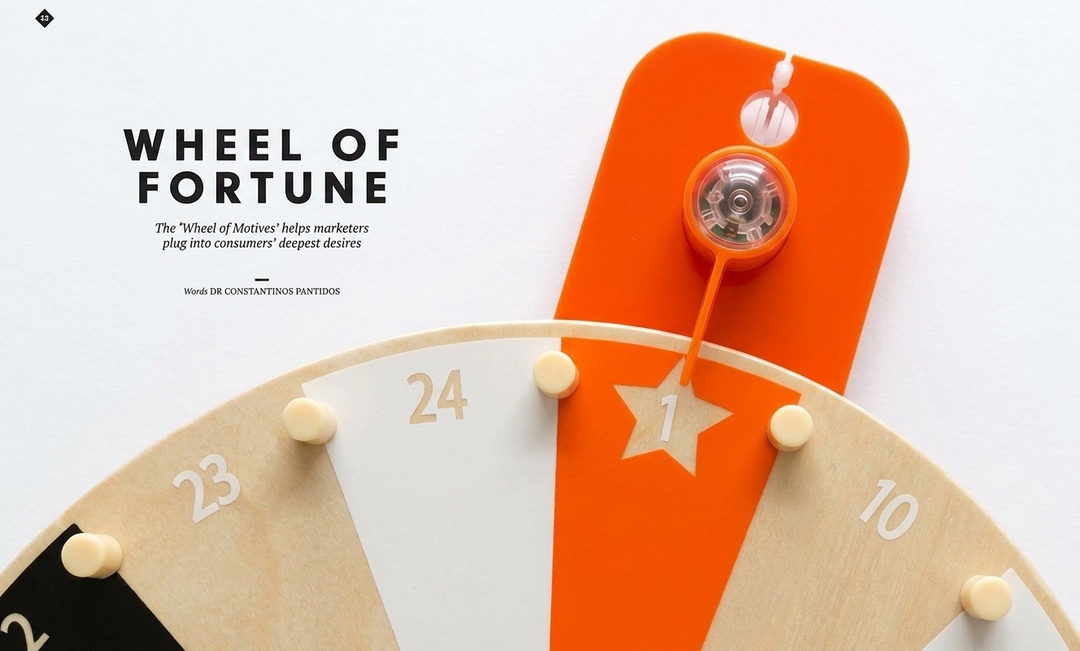
What if marketers could move beyond gut instinct and understand why particular meanings, emotions and experiences resonate with the human brain—and use that understanding to build brands?
Published in Catalyst, the journal of the Chartered Institute of Marketing, this article introduces THE WHEEL OF MOTIVES® as a scientific framework connecting 12 Fundamental Human Motives—deep drivers that have helped humans survive and thrive—to brand strategy and consumer preference.
The starting point is a different way of looking at markets. People do not simply consume categories; they seek to satisfy deeper human needs through them. A jam, a coffee, a car or a service can therefore carry meanings far beyond its functional utility. Understanding the motive beneath the category opens strategic possibilities that conventional category definitions can obscure.
This changes the role of emotion in brand strategy. Rather than deciding that a brand should simply feel reassuring, adventurous or desirable, THE WHEEL OF MOTIVES® gives that emotional territory structure. A fundamental motive can become the basis for strategy and positioning—defining what the brand can authentically own and how it can differentiate at a deeper human level.
A brand may therefore move from simply selling jam to owning reassurance. The product remains important, but it becomes an expression of a larger emotional meaning.
The article then takes the methodology further: how do you make that positioning tangible?
The same motive can be translated into a coherent language of words, colors, shapes, sounds, symbols, materials and other sensory cues, selected according to the meanings they activate. Strategy is therefore not separated from execution: the emotional territory that defines the positioning can become the organizing principle for the communications, concepts, products, packaging and experiences through which people encounter the brand.
Packaging provides a particularly tangible example. Rather than designing a package and subsequently interpreting what it communicates, the emotional essence of the brand can become an input into the physical form itself.
In this way, THE WHEEL OF MOTIVES® connects human motivation → strategy and positioning → tangible brand expression—turning emotion from something marketers discuss or intuit into something businesses can systematically operationalize.
The central proposition is simple:
Treat people as human beings seeking to satisfy fundamental motives—not merely as consumers of categories—and entirely new territories for differentiation, desirability and growth become possible.
Read the original article here: