
The Textures Of Textures
Decoding 12 archetypal textures through human motivation
Initial Problem
In collaboration with a global leader in food texture, BRAND AVIATORS® set out to address a fundamental challenge in sensory innovation.
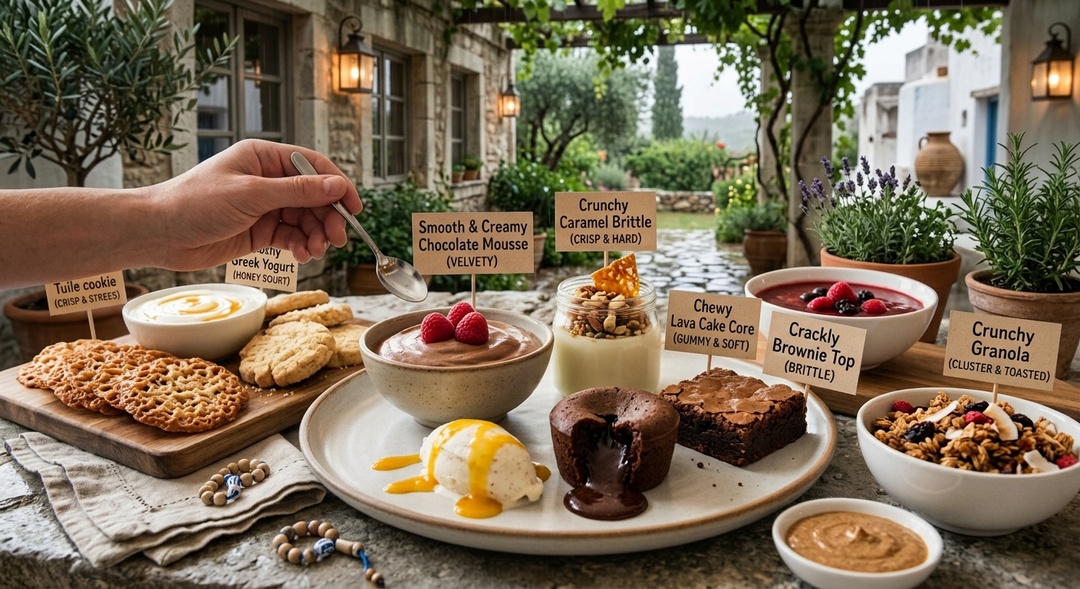
Food texture is typically described through technical and sensory attributes: creamy, crunchy, crispy, smooth, chewy, aerated, thick, melting and many others.
These descriptions tell us what a texture physically is.
But they don't necessarily tell us what that texture means emotionally to a human being.
The ambition was much bigger than creating another texture vocabulary:
Could we identify the fundamental archetypal textures underlying food experience—and connect them systematically to the fundamental motives driving human choice?
Diagnostic Insight
Texture is not simply a physical property of food.
The way something breaks, melts, coats, stretches, resists, flows or disappears in the mouth creates sensory signals that contribute to our emotional interpretation of the experience.
Using THE WHEEL OF MOTIVES®, we approached texture from the opposite direction.
Instead of starting with hundreds of technical texture descriptors and attempting to classify them, we started with the 12 fundamental human motives and investigated how each could be expressed through texture.
The result was the identification of 12 archetypal textural territories.
Not simply twelve textures among hundreds.
The textures behind textures.
Fundamental sensory expressions from which countless individual product textures could be understood, combined and designed.
Intervention
Working with the food-texture leader, BRAND AVIATORS® translated each of the 12 motives of THE WHEEL OF MOTIVES® into a distinctive archetypal texture experience.
The work connected:
Human motive → emotional meaning → embodied experience → texture principles → product expression.
A texture could therefore be understood not only through technical parameters such as viscosity, fracture, elasticity, coating or melt, but through the emotional meaning those physical sensations can help signal.
Different textural expressions could reassure, stimulate discovery, create playfulness, communicate control, suggest transformation, evoke sensuality or support other motivational territories.
This created a bridge between two languages that traditionally operate separately:
the technical language of food texture and the emotional language of human experience.
The Wheel became the translator between them.
Before
Texture innovation largely began with technology.
Product developers could manipulate viscosity, crunch, aeration, elasticity, creaminess, melting behaviour and countless other physical characteristics with enormous technical sophistication.
Consumer research could then determine which textures people preferred.
But one fundamental question remained difficult to answer:
What emotion should this texture express—and why?
Without that connection, texture risked being treated primarily as an attribute to optimize rather than as a strategic component of the product's emotional meaning.
There were thousands of possible textures.
But no simple human system connecting them to the fundamental motivations behind choice.
After
The 12 archetypal textures created a new way to think about sensory innovation.
Instead of asking only:
“Which texture does the consumer prefer?”
teams could begin with:
“Which motive should this product deliver—and therefore what should that motive feel like in the mouth?”
This fundamentally changed the role of texture.
Texture could become part of the emotional design brief from the beginning of product development.
A brand built around one motive could seek textural expressions congruent with its emotional DNA.
A product concept designed to deliver another motive could deliberately explore a completely different textural world.
Innovation teams could use the system to generate new product ideas, evaluate existing products, create sensory guardrails and align texture with flavor, ingredients, color, packaging and communication.
Most importantly, thousands of possible technical texture expressions could now be navigated through 12 fundamental human territories.
The result was not simply a taxonomy of texture.
It was a framework connecting the physics of food with the psychology of human experience.
The Principle
Texture is not only something food has. Texture is something the brain interprets.
Every fracture, resistance, coating, stretch, flow or melt creates information.
THE WHEEL OF MOTIVES® provides a framework for connecting those physical signals with deeper human meaning.
By identifying 12 archetypal textural territories, sensory innovation can move from describing texture to designing texture with emotional intent.
This creates a pathway from motive to emotion, from emotion to sensory expression, and from sensory expression to product design.
Thousands of textures. Twelve archetypal territories. One human motivational system.
THE TEXTURES OF TEXTURES™
Design not only how food feels in the mouth—but what that feeling means.
Have a similar challenge?
Let's explore how human motives can unlock meaning, differentiation and growth for your brand.