
THE SCIENCE BEHIND THE WHEEL OF MOTIVES™
The Wheel of Motives™ was developed through a multidisciplinary approach combining affective neuroscience, evolutionary psychology, cognitive science, semiotics, anthropology, sociology, philosophy, and brand communication decoding to uncover the deeper motivational structures shaping human behavior, meaning, and consumer preference.
* Proprietary tool developed by BRAND AVIATORS™ See: Dr. C. Pantidos, Living Brands: How Biology and Neuroscience Shape Consumer Behaviour and Brand Desirability, Lid Publishing, London 2018, p. 10
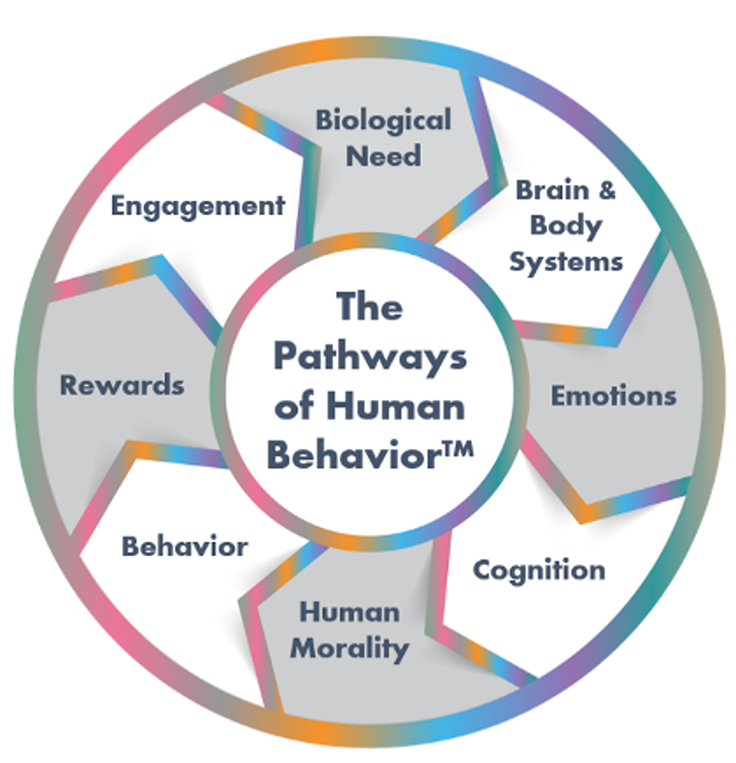
Human behavior is rooted more deeply in biology than in conscious rationality.
Dr. Constantinos Pantidos
Beneath our choices lie fundamental motivational systems
Rather than viewing consumer behavior through isolated disciplines, the framework identifies the biological and emotional patterns that consistently re-emerge across categories, cultures, brands, and human experiences. This approach revealed that beneath our choices lie fundamental motivational systems rooted in survival, adaptation, social belonging, exploration, protection, status, growth, and meaning-making.
These motives are not superficial preferences, but biologically grounded emotional forces that shape perception, memory, decision-making, and the way the brain assigns meaning to people, products, and experiences. What consumers ultimately seek are not simply products, but emotionally meaningful ways of affirming life, identity, and human flourishing.
The Wheel of Motives™ recognizes that human behavior cannot be fully understood through a single discipline alone. By integrating insights from neuroscience, psychology, culture, language, symbolism, and behavior, the framework provides a more complete understanding of how brands become emotionally relevant and cognitively coherent within the brain.
The same fundamental motives that helped humans survive and thrive continue to shape meaning, preference, memory, culture, and brand desirability today.
Dr. Constantinos Pantidos
The Disciplines That Shape Human Behavior
The main theoretical foundations and conceptual frameworks this book is based on, classified according to the discipline and approach to which they most closely relate.
Select to explore each discipline
NEUROSCIENCE
J. Panksepp’s affective neuroscience and basic brain systems,
A. Damasio’s theory of emotions and their biological underpinnings,
S. Zeki’s neural correlates of affective states,
D. Siegel’s interpersonal neurobiology,
J.D. Vincent’s biology of passions
COGNITIVE SCIENCE & LANGUAGE
Fodor’s modularity of mind and language of thought,
Lakoff & M. Johnson’s theory of cognitive projection categories, prototypes, conceptual metaphors and metaphorical groupings,
Chomsky’s innatism,
Pinker’s psycholinguistics

PSYCHOLOGY
C. Jung’s depth psychology, concepts of archetypes and collective unconscious,
S. Freud’s unconscious, structural model, defence mechanisms, psychosexual stages, pleasure principle, psychological projection and peak-shift theory,
A. Adler’s individual psychology, A. Maslow’s Theory of Motivation,
E. Fromm’s theory of human character, D. Winnicott’s objective reality and transitional objects, M. Csikszentmihalyi’s positive psychology, R. Sternbeg’s triarchic theory of intelligence, D. Stern’s infant development theory, J. Tooby and L. Cosmides’s evolutionary psychology, S. Fiske’s social cognition
PHILOSOPHY
Plato’s Doctrine of Ideas, A. Schopenhauer’s notions of will-to-live, representation and matter,
H. Bergson’s élan vital and creative evolution,
F. Schiller’s theory of aesthetics,
M. Heidegger’s philosophical hermeneutics,
J.P. Sartre’s existentialism and phenomenology,
G. Bachelard’s material imagination and combination of philosophy and science,
J. Baudrillard’s postmodern theory and combinatory approach of social theory with philosophy,
C. Alexander’s notion of pattern language, W. Kandinsky’s analyses on forms and colours

CULTURE & SOCIETY
Simmel’s social individuality and fragmentation,
Elias’ civilizing process,
Caillois’ theories on games, play and the sacred, C. Lévi-Strauss’ structural anthropology, M. Douglas’ human culture & symbolism,
Eliade’s interpretative symbolism,
Huizinga’s cultural history and theories of play,
Mithen’s cognitive fluidity

MARKETING & SEMIOTICS
Martineau’s brand personality theory, D. Yankelovich’s nondemographic segmentation, W. Lazer’s lifestyle marketing, P. Lazarsfeld & E. Dichter’s motivational research, A. Ries & J. Trout’s brand positioning theory,
Mark & C. Pearson’s
archetypal analysis, B. Stern’s literary approach to consumer research and postmodern marketing thinking , R. Barthes’ semiotics,
U. Eco’s interpretative semiotics