
Sauce It Up
From flavor innovation to emotionally designed food
Initial Problem
Most food innovation starts with ingredients, flavors, trends or consumer preferences and only later builds an emotional story around the finished product.
Working together with a leading flavor company, BRAND AVIATORS® wanted to reverse that process.
The ambition was to create a new generation of sauces for burgers, sandwiches, street food and other applications where emotion would be the starting point—not the communication added at the end.
The challenge was:
Could we design food systematically from a desired emotional experience backwards—aligning concept, flavor, texture, color and ingredients around the same human motive?
Diagnostic Insight
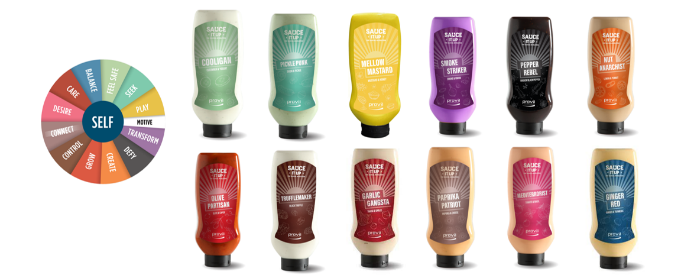
THE WHEEL OF MOTIVES® identifies 12 fundamental motivational territories behind human choice.
But emotions are not communicated only through words.
The brain continuously interprets sensory signals—taste, aroma, texture, color, shape and other cues—and these signals contribute to the meaning and expectations we attach to an experience.
This opened up a very different approach to food innovation.
If each motive has a distinctive emotional meaning, could the sensory characteristics of a sauce be deliberately aligned with that same meaning?
Instead of creating a sauce and then asking how to position it, we could start with the desired emotional territory and ask:
What should TRANSFORM taste and feel like? What sensory world expresses PLAY? DESIRE? SEEK? CONNECT? FEEL SAFE?
The motive could become the design brief.
Intervention
BRAND AVIATORS® and its flavor-industry partner developed SAUCE IT UP: a system of 12 different sauces inspired by the 12 territories of THE WHEEL OF MOTIVES®.
Each sauce began with a different motivational brief.
We then translated that emotional territory across the complete product experience:
Concept → ingredients → flavor → aroma → texture → color → product experience → naming and communication.
A sauce designed around SEEK, for example, could invite exploration through unexpected flavor combinations, unfamiliar ingredients and sensory discovery.
DESIRE could move toward richer, more sensual and indulgent sensory cues.
PLAY could become more surprising, expressive and fun.
FEEL SAFE could draw upon familiarity, comfort and reassuring sensory expectations.
TRANSFORM could create a more dramatic sensory transition or unexpected experience.
Rather than creating twelve flavor variants and giving them twelve different stories afterwards, the process worked in the opposite direction.
Twelve motives became twelve emotional briefs.
Twelve emotional briefs became twelve different sensory experiences.
Before → After
Before
After
This shifted innovation from incremental flavor variation towards emotionally differentiated product experiences.
And because concept, sensory properties and communication originated from the same motivational territory, the product could become more internally coherent.
The emotion was no longer simply communicated around the food.
It was designed into the food experience itself.
The Principle
Emotion should not be added to a product after it has been created. It can become the brief from which the product is created.
THE WHEEL OF MOTIVES® provides the emotional destination.
Sensory and food science can then help translate that destination into the signals people actually experience—flavor, aroma, texture, color, ingredients and product behaviour.
When concept, communication and sensory experience all point toward the same emotional meaning, innovation moves beyond storytelling toward emotional congruence.
SAUCE IT UP demonstrated this across 12 different sauces and 12 different motivational worlds.
Don't just tell people what a product should make them feel. Design the feeling into the experience.
Related materials
Have a similar challenge?
Let's explore how human motives can unlock meaning, differentiation and growth for your brand.