
Beyond What Consumers Can Tell Us: Bringing Biology Back into Research
QUAL360 APAC 2022 — Tanushree Mainrai
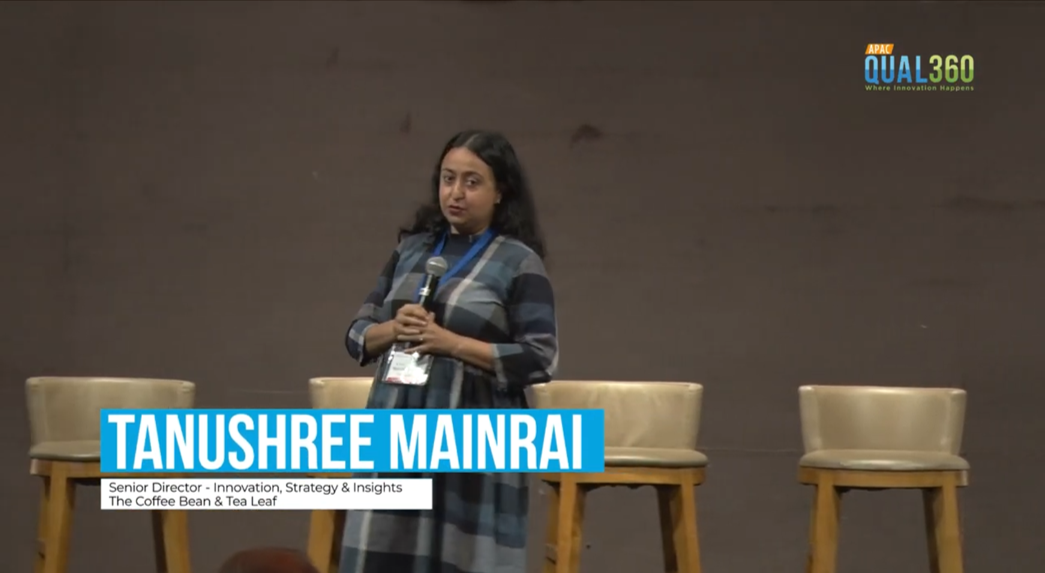
What if one of the greatest limitations of consumer research is not the methodology—but our dependence on what people can consciously tell us?
At QUAL360 APAC 2022, Tanushree Mainrai, drawing on senior insights experience across Kantar, Unilever and AB InBev, challenged some of the fundamental assumptions behind conventional consumer research and made the case for a deeper, more exploratory approach rooted in human biology.
Consumers do not always know why they choose. Even when they do, they may be unable to articulate the deeper emotional forces behind their decisions. Researchers themselves are also human—bringing interpretation, assumptions and biases into the process. Research can therefore become very good at capturing and rationalizing what people say, without necessarily revealing what fundamentally drives them.
Mainrai contrasted this with an approach grounded in biology and fundamental human emotional systems—patterns that precede brands, language and culture and therefore provide a more universal and enduring foundation for understanding human behavior.
As part of this perspective, she highlighted THE WHEEL OF MOTIVES®, describing the framework developed by Dr. Constantinos Pantidos as “stellar work.” Its significance lies not simply in providing another way to classify emotion, but in giving deeper human motivation a structure that businesses can act upon.
This becomes particularly important when research moves from understanding people to deciding what should be created for them. Once a deeper motivational opportunity is identified, it can inform strategy and positioning and then travel downstream into the concepts, experiences, products, packaging, communication and other touchpoints through which that emotional meaning becomes tangible.
The O-I case, presented by Mainrai, demonstrated this progression in practice. Biological understanding of human motivation was not used simply to measure consumers' reactions to packaging. It helped uncover emotional territories and translate them into brand and packaging strategy—and ultimately into the physical and sensory language of glass itself.
Drawing on examples such as the Sony Walkman—an innovation that conventional research might never have predicted—Mainrai also questioned the industry's growing dependence on validation: test, test, test. When research becomes primarily a mechanism for evaluating ideas already created, it risks losing one of its most powerful roles: discovering possibilities nobody has yet imagined.
Her argument therefore points toward a different philosophy of insight. Research should not only validate what companies already intend to create. By going beneath stated preferences to understand the deeper motives behind human choice, it can help reveal new strategic territories, new positionings and ultimately new things worth creating.
Because the greatest opportunity for research may not be to ask:
“Will consumers like this?”
But to discover:
“What could people deeply desire that does not yet exist?”